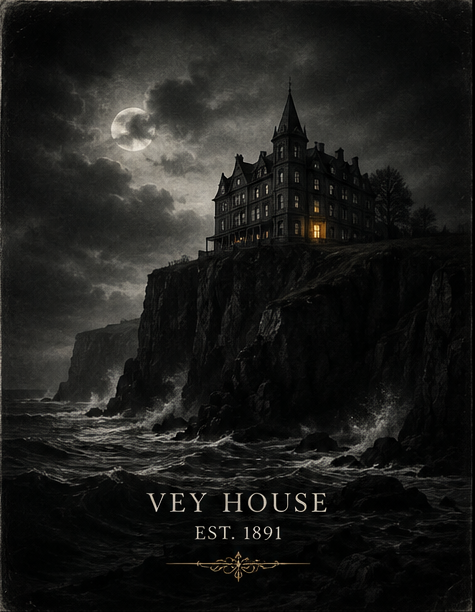
The Light in the East Wing
The hotel was supposed to be empty. That was the first thing Mara Vey thought when she saw the light in the east wing.
She stood beside the rental car with rain needling the back of her neck and counted the windows again. Eleven faced the sea. Ten were black. The last glowed a muted amber, four floors above her.
Mara checked her phone. 6:47 p.m. No signal. Nine per cent battery.
Naturally.
The sensible thing would have been to drive back into town — find a hotel with central heating and functioning Wi-Fi, come back tomorrow with the surveyor and the estate agent, when there’d be enough daylight to make Vey House look like what it actually was: an expensive problem made of stone.
But the buyer was due on Thursday. The solicitor had already delayed completion twice. And Mara had spent twenty-seven years avoiding this place — one more night wasn’t going to make that any easier.
She opened the boot and took out her bag. The wind caught the car door and nearly tore it from her hand. Beyond the hotel, the sea was invisible in the rain, but she could hear it striking the cliffs below.
Vey House stood above the water like something that had endured rather than survived: four storeys of grey stone, a slate roof, narrow windows, chimneys that hadn’t drawn smoke in years.
Her grandfather had called it a hotel. Her father had called it home. Mara had always thought it looked like somewhere people waited for bad news.
She hurried toward the entrance. Faded gold lettering remained above the doors.
VEY HOUSE
EST. 1891
The date caught her attention. She remembered 1908 — that was the date printed on old menus and stationery. Another item for the surveyor.
She fitted the largest brass key from the solicitor’s envelope into the lock. It turned. The door opened.
Darkness waited inside.
Mara found the switch. Nothing.
“Good start.”
Her voice travelled too far into the building.
She switched on her phone torch. The lobby emerged in pieces: black-and-white marble, furniture under dust sheets, a reception desk of dark oak. A staircase divided halfway up before climbing toward the east and west wings, and above it hung an enormous chandelier — her father had once told her it held eight hundred pieces of glass. She’d believed him, because she was six, and because fathers were allowed impossible numbers.
Mara set down her bag. Something moved behind reception.
Her light snapped toward it.
Nothing. Only an open ledger on the desk. She approached. The pages were blank.
Then somewhere above her, a piano played seven notes.
Mara froze. Three. Pause. Four. Silence.
She stared at the staircase.
“Hello?”
No answer.
She almost laughed at herself. Caretaker. Squatter. Estate agent who had forgotten to tell her someone had access. There were explanations — Mara made a living from explanations, from buying struggling businesses, separating sentiment from value, finding the reason numbers did not reconcile and making them reconcile.
Buildings did not decide things. Buildings did not remember. And buildings did not play pianos.
A floorboard creaked upstairs.
Mara took the master keys.
“Whoever you are, you shouldn’t be here.”
No response.
She climbed. The first floor smelled of damp plaster. The second smelled faintly of smoke — not old smoke. Wood smoke. Recent.
She stopped.
“Definitely someone here.”
The third-floor corridor was lined with framed photographs: weddings, staff portraits, families standing on the hotel steps. She recognised her grandfather in one. Beside him stood her father at perhaps nineteen — Daniel Vey, dark hair, broad shoulders, a grin she had almost forgotten.
There was a third person in the photograph. A man. Someone had scratched away his face — not the photograph, only the face. Deliberately.
Mara lifted the frame from the wall. On the back, in faded ink: August 1978. Daniel, Adrian, George.
Adrian. The name meant nothing to her.
A sound came from the floor above. Footsteps. Mara replaced the photograph and climbed.
The fourth floor was different. No dust. The corridor carpet was faded but clean, the brass room numbers polished. And somewhere nearby was the unmistakable smell of coffee.
Mara slowed. Rooms Nine. Ten. Eleven. Twelve. Then wall.
She frowned. The plans she had been sent showed fourteen guest rooms on the fourth floor.
She moved the phone light across the wallpaper. A vertical seam. Then another. A door had been papered over.
Mara ran her fingers down the edge until she found a brass knob concealed beneath several layers of paper.
“Of course.”
She tore the wallpaper. The sound cracked through the corridor. Beneath it was a dark wooden door, a tarnished number fixed to the centre.
13
Mara reached for the handle.
The door opened before she touched it.
The complete edition is on Amazon Kindle. The live book link can be added without changing this page.
Kindle link coming shortly